INTERLOCK, release orchestration control plane
Role: creator · Where: Metafora / CarrierDirect · Built: June–July 2026 Stack: .NET · C# · React + Vite + TypeScript · OpenAPI contract-first · Authentik OIDC · Bicep
Deploy is not release.
INTERLOCK assembles dependency-ordered release candidates from work that is provably ready, validates them on isolated ephemeral environments, promotes them to production deployed-but-dark at zero traffic, and exposes them to users only by deliberate, attributed feature-flag flips.
It uses a railroad metaphor end to end: tickets are cars, a release candidate is a consist, the ephemeral environment is a siding, production is the main line.
How it was built, the AI angle
This is the project I point at when someone asks what AI-assisted development actually changes.
- Design handoff, not a wireframe. The product started as six HTML/CSS/JS prototype screens produced in Claude Design. Those prototypes, not a PRD, were the source of product truth.
- Reverse-engineered into a spec. Using GitHub Spec Kit, the prototypes were turned into a real spec: 8 user stories, FR-001…FR-054, a research pass across 11 technology areas with explicit feasibility verdicts, a data model, a glossary, and a task list.
- Contract-first, then behavior. The OpenAPI document is the single source of truth for every data shape; .NET and TypeScript DTOs are generated from it. Shapes get frozen, the shell gets pressure-tested, then behavior iterates.
- The AI was made to argue with the design. The research pass found three things the prototypes
promised that the platforms cannot actually deliver as drawn, and the ADRs adopt the corrected
design instead of the prettier one:
- Sidings are host/subdomain-isolated, not "header-routed": Azure Container Apps has no header matcher (ADR-0001).
- "Contract fully implemented" is a two-tier check: static API-gateway parity caps out at AMBER; behavioral tests on the siding decide READY (ADR-0002).
- Live-dark is owned by flags-off + expand/contract, not by the traffic weight (ADR-0003), and a human signature alone does not make a destructive migration safe.
Measured 123 commits across all branches in ~3 weeks, 105 of them (85%) co-authored by Claude. Tied for the highest AI-co-authorship share of any project here (Cloud Topology Toolkit matches it on five times the commits), and the one with the most non-negotiable correctness core.
What stayed human the readiness algebra. ReadinessEngine (six conditions, strict precedence,
evaluates all dependencies), TopologicalOrder, VersionPolicy, and LifecycleStateMachine are
hand-specified and covered by 34 domain tests. Every integration adapter sits behind a port and is
cleanly stubbed. The line between "real + tested" and "typed seam" is documented, not fudged.
The screens
Every screenshot below is captured from the running stack by a Playwright spec and regenerated when the UI changes. If a screen changed and its screenshot didn't, the change isn't done. That rule is in the project constitution.
The Yard: what's ready, and why
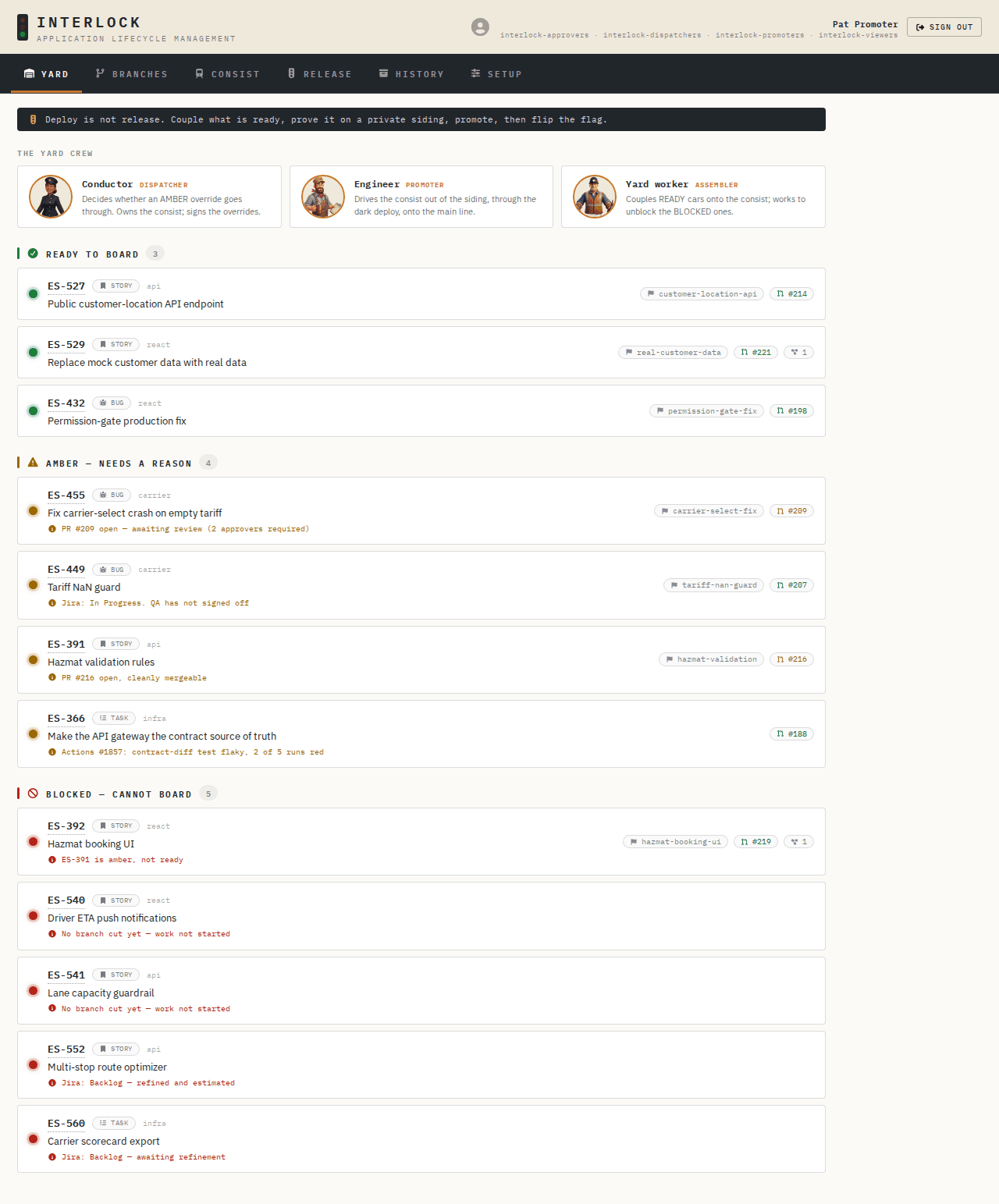
All work on hand, grouped by readiness. Green boards freely. Amber means one condition is soft ("Jira: In Progress, QA has not signed off", "PR #209 open: awaiting review, 2 approvers required") and the car can be force-included only with a logged, attributed reason. Red means a hard condition fails ("ES-391 is amber, not ready", "Actions #1857: contract-diff test flaky, 2 of 5 runs red") and the car cannot board at all.
Each card traces its verdict back to an external source of truth (Jira, GitHub, CI, the API gateway, LaunchDarkly) and shows that evidence inline rather than asking you to trust a rollup. The Yard Crew strip along the top states who is allowed to do what: the Conductor decides whether an amber override goes through and signs it; the Engineer drives the consist through the dark deploy onto the main line; the Yard worker couples ready cars and unblocks the blocked ones. Roles come from IdP group membership, so the picture and the permissions can't drift apart.
The Consist Wizard, assemble a release candidate
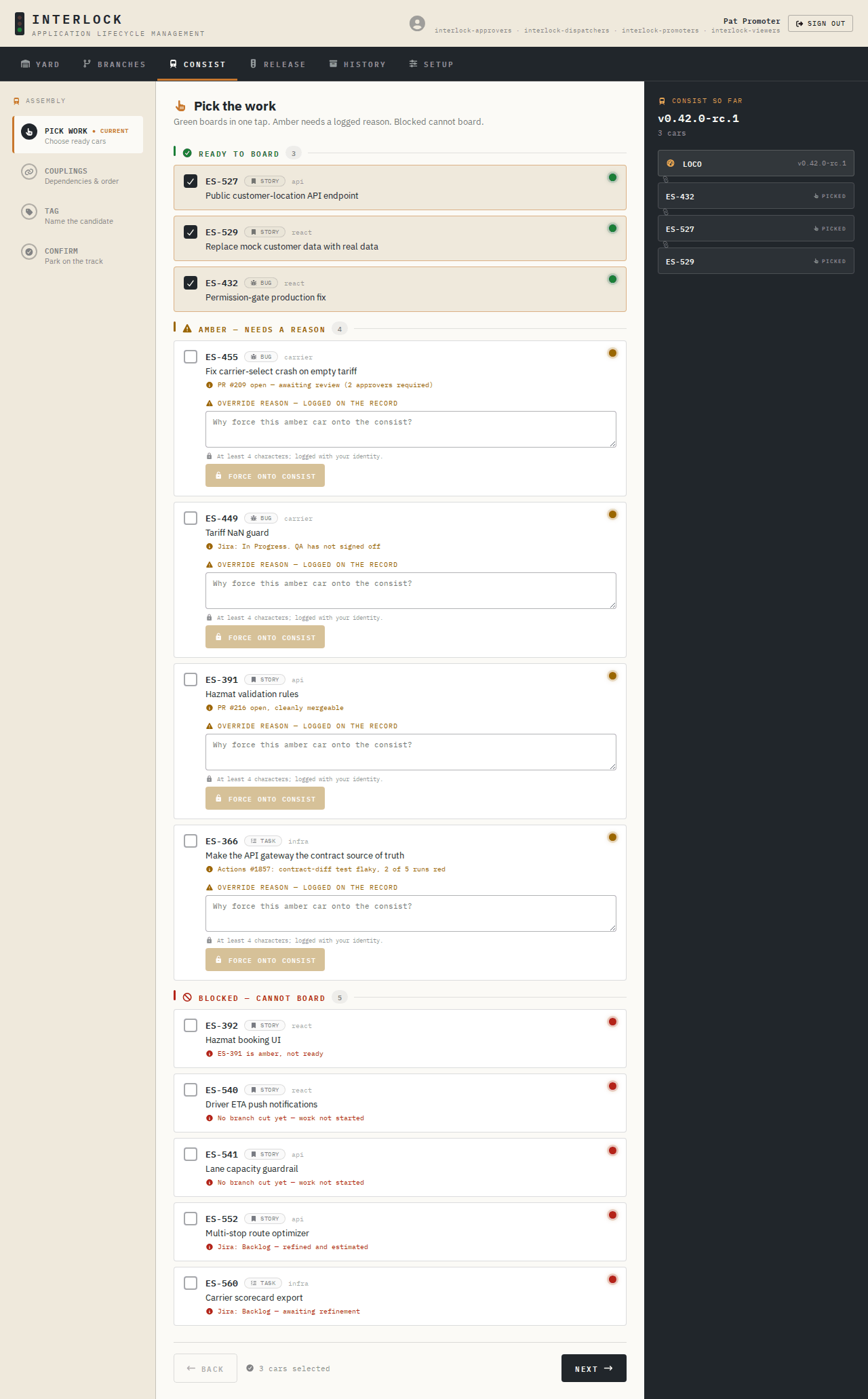
Four steps: Pick work → Couplings → Tag → Confirm. Green cars board with one click; dependencies
auto-couple in topological order and the version auto-bumps (v0.42.0-rc.1 here). The dark
CONSIST SO FAR sidebar shows the LOCO and the ordered train beneath it.
Every amber car opens an inline "Why force this amber car onto the consist?" box: minimum character count, logged with your identity, before FORCE ONTO CONSIST unlocks. Blocked cars have no such affordance at all. The guardrail is the only path through the UI, not a policy someone might follow.
The Release cockpit, validate → promote → expose → file
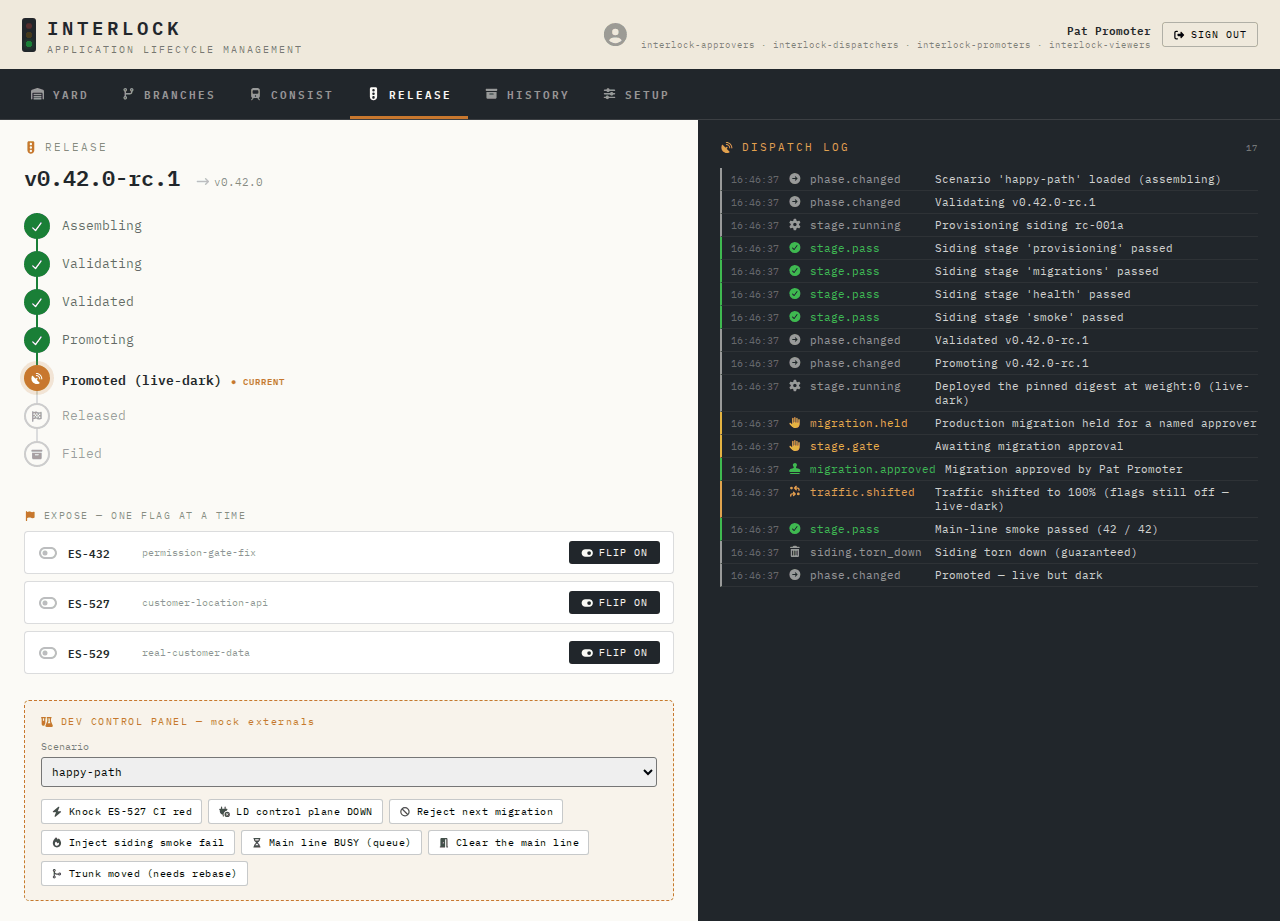
Validate runs the checks on a siding. Promote deploys at weight 0 and holds at the migration
gate for a named approver; once approved, traffic shifts to 100% with every flag still off: present,
serving, observed by no user. The weight shift is deployment; exposure stays with the flags.
Expose flips one flag at a time (that is the real release). File
stamps the Jira fixVersion, appends the immutable ledger, and reopens the yard. Every transition
publishes a dispatch event over SSE, so the run is observable as it happens: in this capture,
migration.held → migration.approved by Pat Promoter → traffic.shifted to 100% (flags still off, live-dark). Three flags sit below the stepper, each with its own FLIP ON; the release happens one
row at a time.
The amber DEV CONTROL PANEL at the bottom is the part I'd point at in an interview. It exists only
in local/dev mode and lets you pick a scenario (happy-path, ci-flaky, migration-rejected,
promotion-fails-rollback, promote-queued, needs-rebase, rolled-back-recover) or poke the mocked
externals live: knock ES-527 CI red, LD control plane DOWN, reject next migration, main line
BUSY (queue), trunk moved (needs rebase), and watch the system react in the dispatch log. Building
the failure modes as first-class, drivable states is what let the unhappy paths get designed rather
than discovered.
The unhappy paths are first-class
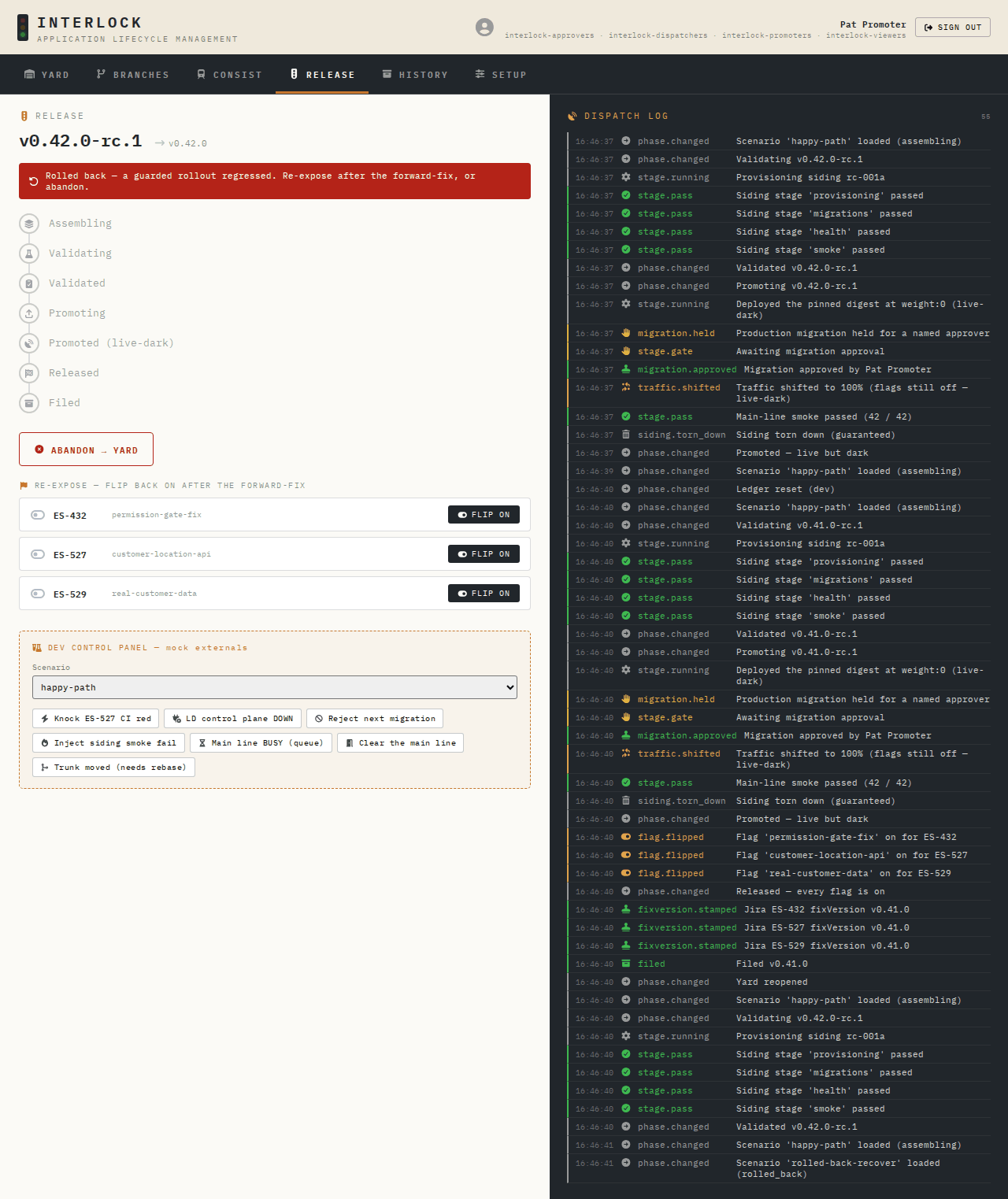 Rolled back: a guarded rollout regressed and the flag auto-turned off. The fix is forward-fix + flag-off: re-expose each flag to return to released, or abandon the consist back to the yard. |
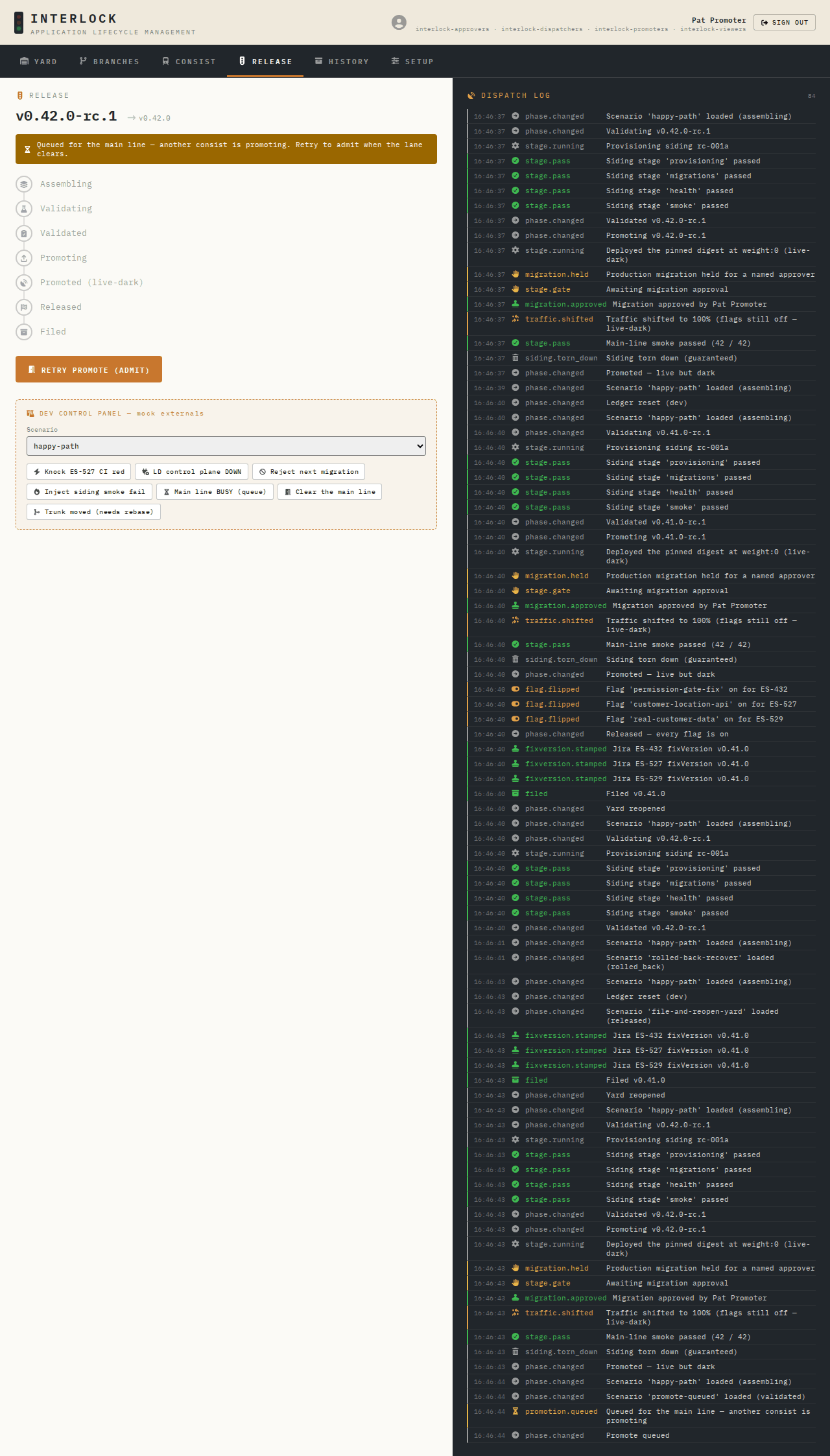 Promote queued: production is one main line, so promotions serialize. When another consist holds it, a promote queues (FIFO) instead of racing. A stale train must rebase before it can re-validate. |
Why it matters
Most "release tooling" conflates deploying a binary with exposing a behavior, which is why rollbacks are scary and audits are archaeology. INTERLOCK separates the two, makes every override attributed, and treats queueing, rebasing, and rollback as normal states with a documented way back, not as incidents.
Provenance. Every screen above is a Playwright capture from the running containerized stack against the seeded reference backlog: no live customer tenant, no customer data. The product's own branding is what you see; the
ES-prefix is the seed's synthetic ticket key.